Die Existenz und Einheit Gottes
The 13 principles of faith. I have not encountered the idea that they differ for Jews and Noahides — they are the same for everyone. Later we will discuss what principles of faith are and how they should be understood.
In addition to this, naturally, one should study the Torah itself, its individual parts, Tanakh, history, and worldview. So there is a wide range of topics for study here. If you have any specific wishes, be sure to say so, and we will be able to adjust the program, perhaps divide the lessons or adapt their format. We are currently searching, working in an interactive mode.
Today I would like to begin specifically with the 13 principles of faith: what they are, what they mean, and who formulated them. I will say right away: we will not cover everything in one lesson, perhaps not even in several, but we will move forward gradually.
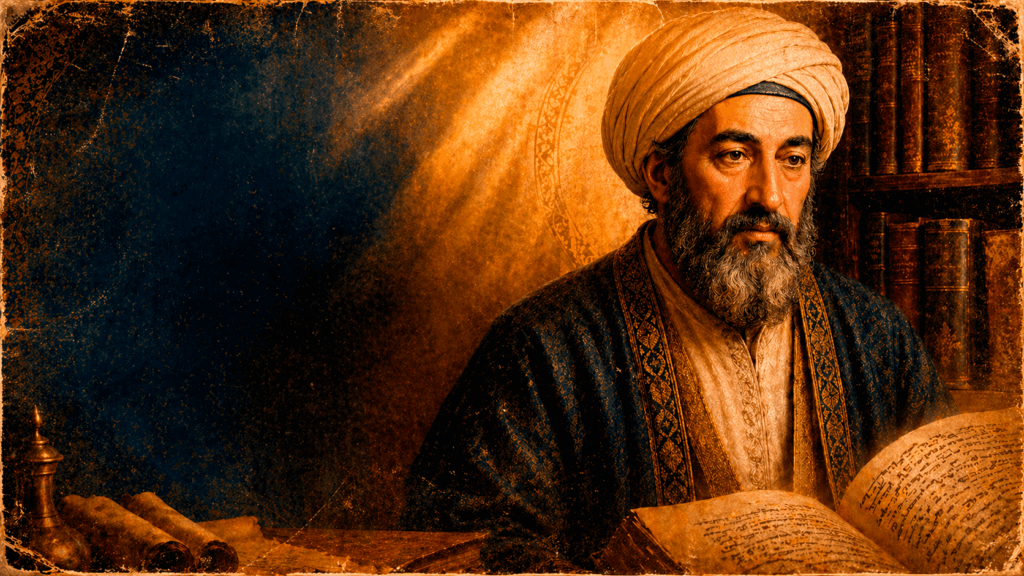
So, who formulated the 13 principles? It was Moshe ben Maimon. Not everyone knows this. At the same time, there were other sages who disagreed with him: some claimed that there were not 13 principles, but 3 or 5. But it is important to understand that they did not disagree with the ideas themselves. Everyone agreed with the content; the dispute was about whether a particular statement should be considered a principle.
For example, one of the principles is the incorporeality of God: the Almighty has no body, image, or form, and the limitations of space and time do not apply to Him. But a question arises: after all, in the Torah we encounter expressions such as “the hand of God,” “the eyes of God,” “the Almighty rejoices,” or “is angry.”
The sage Avraham ben David disagreed with Rambam and argued that incorporeality is not a principle. He agreed that God has no body, but he held that a person who mistakenly understands the texts literally does not thereby become a heretic. In other words, such a person may be mistaken, but this does not place him outside the bounds of faith.
From this we see that the dispute was not about the content, but about the status. If something is a principle, then denying it places a person outside the boundaries of Orthodox Judaism. If it is not, a person may be mistaken and still remain within.
For example, belief in the coming of Moshiach. According to Rambam, one who denies it leaves the boundaries of Judaism. Other sages thought differently. Nevertheless, Jewish tradition accepted Rambam’s position, and the 13 principles became foundational.
Now it is important to understand the difference between principles and commandments. Commandments are actions that take place in time and space: for example, putting on tefillin, visiting the sick, praying. There are commandments of action, speech, and even feeling — for example, loving one’s fellow or loving God.
Principles are not actions. They are a worldview, what a person believes. A person who accepts all 13 principles is within Judaism. One who denies even one of them leaves its boundaries.
Now let us list the principles themselves:
- The existence of God.
- The unity of God.
- The eternity and timelessness of the Creator.
- Incorporeality.
- The prohibition against serving anyone other than God.
- God communicates His will through prophets.
- The uniqueness of Moshe’s prophecy — it is unique.
- God knows people’s thoughts and deeds.
- Reward and punishment.
- The Torah was given through Moshe.
- The Torah is unchanging.
- The coming of Moshiach.
- The resurrection of the dead.
Now let us return to the first principle — the existence of God. There is a well-known statement: “Moshe commanded us the Torah.” The sages explain that the numerical value of the word “Torah” is 611, while the total number of commandments is 613. Two of them — “I am the Lord your God” and “You shall have no other gods” — were perceived directly from the Almighty.
From this, the conclusion is drawn that a person is capable, through his own reason, of arriving at two truths: that God exists and that He is one. Revelation is not required for this.
And here an important question arises: how do faith and reason relate to each other? Do they contradict each other?
In truth, they do not. Reason leads a person toward faith, and faith confirms that conclusion. Faith is not merely content; it is a faculty of the soul. Every person has this faculty, but the question is what he believes in.
People believe in all kinds of things: in God, in ideologies, in omens. Even the statement that “the sun will rise tomorrow” is not pure knowledge, but contains an element of faith. The philosopher David Hume showed that we cannot logically prove the future on the basis of the past — we simply believe in the stability of the world.
Thus, faith is an inner force. Reason helps filter out falsehood and lead toward truth, and then the act of faith enters — an inner decision, a choice.
In Kabbalah, this is connected with the concept of keter — the crown, the highest power of the soul, standing above reason. It is connected with faith and will. Reason analyzes, while faith affirms and secures.
For example, the idea of a Creator is not merely a reasonable hypothesis; it is the most logical explanation of the world. Imagine that you found a phone in the desert. You would not say that it randomly formed itself out of sand. It is even stranger to say such a thing about the far more complex world.
Thus, faith and reason are not opposites — they complement one another.
And one final question: is there a commandment to believe? Some say there is not — because if a person does not believe, who is commanding him? But Rambam maintains that such a commandment does exist: a person must reflect, strengthen faith, and work on it.
Faith is not merely a given; it is a process. It must be developed, deepened, and made conscious. This is exactly what we will continue doing as we examine each of the 13 principles in greater detail.
Many people say: there is some force that created everything. But then the question arises: does this force play any role in your life? Here there are already fewer people. Even fewer are those who bring this faith to the level of reason, emotion, and action.
The final level is when one’s entire life is permeated with the Almighty. The entire purpose of Judaism is to show that the Almighty is everywhere. There is no area of life that Halacha, the law, does not touch. A person gets up in the morning — there are laws for how to get up; he washes his hands — there are laws; he eats — there are laws about what, how, and where one may eat. There are laws of conduct in the bathroom, laws of marital intimacy, and even laws connected with departing from this world.
This tells us that the ideal of life is not to leave even a single detail outside the presence of the Almighty. It is not that a person comes to synagogue, prays, and then leaves — and a different life begins. No. The Almighty is with him everywhere. And the task is to reveal His presence in all areas of life.
The Ten Plagues were also lessons in faith. They seemed to say: here I am, and here, and here. They showed, down to the smallest details, that the Almighty is present everywhere.
The commandment of faith is a form of training, work aimed at making the absolute existence of the Almighty an inner reality for a person. The first principle is not merely the recognition that God exists. It is the recognition that He exists, continues to govern, intervene, observe, and direct everything.
We must develop this: think, reason, reflect. This, in particular, is the path of Chabad. Chabad is an acronym for the words Chochmah, Binah, Da’at: wisdom, understanding, and knowledge. These are three intellectual faculties. Chabad emphasizes that a person reaches a true inner result through contemplation.
Faith is higher than reason, but a person comes to it through reason. First he examines, reflects, rejects falsehood, and then gives himself over to faith.
There is a well-known verse from Shir HaShirim, the Song of Songs: “I am my beloved’s, and my beloved is mine.” The Jewish people are compared to a young woman seeking her true beloved. She rejects all those who are unsuitable, examines, waits, and in the end recognizes the true one.
So too with a person: various philosophies, religions, and ideas come to him. He must examine them with reason. And when he sees the truth, then the Almighty is revealed to him.
So, the commandment of faith is to strengthen faith in the heart. This is done primarily through contemplation, though also through actions. There have been different approaches: some said that one must abandon reason and proceed with pure faith; others said that action is the main thing. Each approach has its place, but for the most part, faith is strengthened through understanding.
Now let us move to the second principle — the unity of the Almighty. The first two principles can be understood by a person without revelation: that the Almighty exists and that He is one.
What does “one” mean? On the simplest level, it means that there is no other. And this too can be reached through reason. If there are two or more, then each of them is limited in some way: one is not the other, and the other is not the first. If each is limited, then there must be someone who established those boundaries. And the one who established the boundaries must himself be beyond boundaries.
Science deals with laws: physics with physical laws, biology with biological laws, psychology with psychological laws, economics with economic laws. A law is a limitation, a pattern: this is how things always happen. But if there is a law, the question arises: who established it? Why is it this way and not otherwise?
Scientists usually stop at describing the law. But one can take a step further and ask: who established the pattern itself? If there is a limitation, then there is One who stands above limitation.
The Almighty is not limited by the laws of nature. He created them, but He Himself is above them. At the same time, He does not “like” to violate the laws of nature without necessity. Therefore, Judaism has a complex attitude toward miracles.
There is a story in the Talmud: a man’s wife died during childbirth, and there was no way to feed the child. The Almighty performed a miracle, and the man produced milk. One sage said: how great is this man, for whose sake God changed the laws of nature. Another said: how lowly is this man, for whose sake the Almighty had to change the laws of nature. And both are right.
Another story: the son of a sage asked a tree to produce fruit before its time so he could pay workers. The fruit appeared. But his father said that his son had burdened his Creator by making the tree bear fruit before its time, and this was taken extremely seriously.
These stories show that a miracle is not simply “a good thing.” The Almighty created the laws of nature so that the world would exist within their framework. Miracles occur when necessary, for example at the giving of the Torah or the Exodus from Egypt, but not as a constant violation of order.
Now the question goes deeper: is the Almighty limited by the laws of logic? If He is not limited by the laws of nature, then He is not limited by the laws of logic either. Logic too is part of the created order. An even more difficult question: is He limited by the laws of morality? Morality itself is also His instruction, His will.
Socrates formulated a similar question: is good good in itself, and therefore God loves it, or is it good because God loves it? From this perspective, the answer is closer to the second: good is what the Almighty established as good.
The Almighty is limited by nothing: neither nature, nor logic, nor morality. In Chasidic thought, this is connected with the level called Atzmut — the Essence of the Almighty, where there are no limitations at all. Even infinity, if one says “only infinite,” can also be considered a limitation.
Paradoxes such as “Can God create a stone that He Himself cannot lift?” are things that our reason is not truly capable of containing. It is better not to build faith on them, but to understand the limits of human reason.
The same applies to the commandments. The commandments have meaning — and at the same time, their source is higher than meaning. For example, in kashrut one can look for explanations: health, influence on the soul, the spiritual qualities of food, impact on spiritual worlds. All of this may be true on its own level. But at its root, a commandment is the will of the Almighty.
He Himself created reality in such a way that violating a spiritual law affects a person just as violating a physical law does. If a person eats poisonous mushrooms without knowing that they are poisonous, he will still be poisoned. The same is true of spiritual laws: whether a person knew or did not know, reality operates.
The laws of the Almighty are the laws of reality. Their source is His will, and in their manifestation they have meaning and consequences. Therefore, it is correct to say both: the commandments have meaning, but their root is higher than meaning.
Returning to the second principle: the unity of the Almighty means that there is only one Creator, and there is no other deity. Any limitation points to the One who imposed the limitation. And the One who imposed the limitation is Himself limited by nothing. Therefore, there is one Creator.
In polemics with other religions, this is especially important. Judaism, Islam, and Christianity are called monotheistic, Abrahamic religions. Islam, in this sense, is indeed understood as a strictly monotheistic religion. But the Christian idea, from the point of view of Judaism, is regarded as shituf — partnership, meaning the recognition of one Creator together with something else. From the Jewish point of view, this violates the principle of absolute unity.
Unity means that there is no independent auxiliary force: not among angels, not among stars, and not among any spiritual powers. All of them are like a pen in a person’s hand. If a person wrote a letter with a pen, we thank the person, not the pen. So too, angels, stars, and all the forces of the world are merely instruments in the hands of the Almighty.
He is one, and no force has any independence.
When a person raises his hand, no one says: “Your hand raised itself” or “Your muscles are twitching.” We say: “Why did you raise your hand?” If one person hits another, we do not say to him: “Your hand is hitting.” We say: “Why are you hitting?” When I speak with you, I am not speaking to your body, or to your face, or even to your brain. I am speaking to you — to the one who stands behind all of this.
In exactly the same way, the Almighty is hidden behind the universe and nature. He governs everything. When scientists explain why it rained, they say: clouds, the Gulf Stream, and so on. They are correct, but on what level? On the level of a physiologist who explains a raised hand by the contraction of muscles. That is true, but one can go deeper: why did it happen? Even deeper — the levels of angels, the worlds of Beriah, Atzilut, and so on. And everything begins with the fact that the Almighty willed it.
There is no contradiction here between nature and the Almighty. They are one. This is what we call the time of Moshiach: when it will be revealed how the Almighty governs everything. We will see the laws of nature, but just as now we do not say “the hand raised itself,” but “you raised your hand,” so too we will see the Almighty in everything, without contradicting the laws of nature.
This too is part of the principle of unity. Until now we have said: there is no other God — this is the first level. Next: there is no partner, no independent force, no angel that possesses independence. This too is included in the principle of unity and belongs to the obligation of Bnei Noach. When we study concrete Halacha, you will see that this is written in law. For now, we are speaking about the principle from the point of view of Judaism: there is no independent force.
The next level is good and evil. People often say: good comes from the Almighty, but where does evil come from? But this too is included in the principle of unity. There is evil that people do, and there is evil that happens as though for other reasons: earthquakes, hurricanes, and so forth. To avoid complicating matters, let us say in general: everything that happens to a person, even what appears to be evil, comes from the Almighty.
How to relate to evil and why it exists is a separate discussion. But the principle of unity states: both good and evil, everything comes from Him. Every morning in prayer we say: “Who forms light and creates darkness.” The Almighty creates both light and darkness.
There is a well-known story: a professor at a university said that the existence of evil in the world proves that God does not exist. Then a student asked: can cold be measured? The professor answered: of course. The student said: in reality, we do not measure cold; we measure the presence or absence of heat. Likewise, we do not measure darkness; we measure the amount of light. So too, evil is the concealment of the Almighty, a lesser revelation of His presence.
When a person encounters evil in his life, he often asks: “Where is the Almighty?” or “Why did this happen?” Why is it important for him to understand “why”? Because if he sees the reason, if he sees the connection, it becomes easier for him. Pain is intensified when a person does not understand the reason and connection between events. The revelation that every event has a reason and that the Almighty governs everything — this is the revelation of unity.
A higher level is to understand not only that every event has a reason, but that every apparent evil ultimately leads to good. This is difficult to prove and difficult to accept emotionally. Losing one hundred dollars is one thing; catastrophe, death, and severe events are another. Emotionally, this is very difficult. But from the point of view of Judaism, this is faith: all apparent evil not only has a reason, but leads to good. This is the principle that “everything is for the best,” and it too is included in the principle of unity.
This is truly inner work. One can understand it intellectually, but emotionally it is difficult to accept. We remember Rabbi Akiva, who was walking among the ruins of the Temple. The sages were crying, but he was laughing. They asked: how can one laugh when jackals and foxes run through the holy place? He answered: that is exactly why I am laughing. If the prophecy of destruction was fulfilled, then the prophecy of renewal will also be fulfilled.
In Chasidic thought it is explained that destruction is necessary for a higher renewal. A person will not demolish his house unless he intends to build a better one. If he destroys the old house, it means he wants to build something greater. So too, the Almighty does not destroy His Temple without a higher purpose. This does not negate the chain of cause and effect, nor the fact that the destruction is connected with sins. All of this is one.
And finally, an even deeper level of the principle of unity is connected with the origin of matter. What is a table made of? Molecules. Molecules are made of atoms. Atoms are made of smaller particles. If we go deeper and deeper, we approach spiritual reality: letters, energy, the spiritual force that constantly sustains and creates the world.
The world seems to us solid, physical, real. And we do not deny the reality of the world. But in Chasidic thought it is explained that the words with which the Almighty created heaven and earth were not simply spoken once in the past. They constantly continue to create and sustain the world. If this sustaining force were to cease even for a moment, the world would disappear like a computer whose plug has been pulled out.
A person sits at a computer, plays a game, and thinks that all of it is serious. But behind it there is code, and that code is powered by energy. This is an analogy for our world. If one asks: is the Almighty present in this table? The correct answer would be: there is nothing in this table except the Almighty. All of it is His power. Of course, there is a distinction between Him Himself and what He created, but we will not enter into those subtleties now.
The principle of unity means that everything created in the world is constantly nourished and sustained by His power: the material and the spiritual, from the smallest microbe to the highest angels. The world is real because the Torah says: “In the beginning God created heaven and earth.” The Torah teaches us how to relate to the world. There are things that are forbidden, and there are things that are permitted. We accept the rules of the game of this world, while understanding that at the foundation of everything are the power and word of the Almighty, sustaining the world every second.
So, within the principle of unity we have identified four levels. First: there is no other deity. Second: there is no independent force, partner, or intermediary. Third: even apparent evil also comes from Him and leads to good. Fourth: all matter and everything that exists constantly receives its being from Him.
If we speak about the laws of Bnei Noach, a person is obligated to believe and know that there is one Almighty, that there is no other God, and that there is no force that could be His partner or oppose Him. For example, the idea of Satan rebelling against God is, from the point of view of Judaism, mistaken. In Judaism, Satan is an angel, a servant, fulfilling his role. Just as in a court there is a prosecutor whose task is to accuse, so too Satan has a role — to tempt and accuse. But he is not an independent force; he is a servant of the Almighty.
In the Zohar, an example is given: a king decided to test his son and hired a woman to seduce him. She plays her role well, but who is interested in the son withstanding the test? The king, the son, and she herself. Her task is to create a test, but she too wants the son to stand firm. This is the attitude toward Satan: he fulfills a role, but he does not rebel against the Almighty.
Only one created being can rebel against the Almighty — the human being.
Here it is also important to mention the difference from certain other religious concepts. In Christianity there is the idea of salvation: a person is born with a sinful nature, and his task is to be saved. In Judaism, the emphasis is different. Our immortal soul comes into a created body precisely in order to work in this world. There is no point in simply “escaping” from here. The goal is to connect the material world with spirituality, to reveal the Almighty here, within materiality.
The giving of the Torah occurred specifically here, in the material world. The Torah must connect with real life, not by canceling material laws, but by revealing the Divine within them. The time of Moshiach is a state in which we will see, behind all processes, the One who governs them — just as behind a raised hand we see not the muscles, but the person who raised the hand.
Adam before the sin was on a very high spiritual level. But after the coming of Moshiach, the level will be even higher, because Adam had the possibility of falling, while then such a possibility will no longer exist. The entire descent was intended for the sake of a future ascent, in order to illuminate the very darkness itself.
If the Almighty created both the material and the spiritual worlds, then He is higher than both the material and the spiritual. He is neither material nor spiritual in our understanding, because He created both materiality and spirituality.